UPSC Engineering Services Exam (ESE) MCQs
Prepare effectively for the UPSC Engineering Services Exam (ESE) with a comprehensive collection of multiple-choice questions (MCQs). These practice questions cover all key subjects such as Electrical Engineering, Mechanical Engineering, Civil Engineering, and Electronics & Telecommunication Engineering. The MCQs are designed to reflect the actual exam format, helping aspirants strengthen their knowledge, boost problem-solving abilities, and improve exam time management. Whether you're just starting your preparation or revising for the exam, these ESE MCQs are an essential resource to guide you toward success in the UPSC Engineering Services Exam.
Q1. What is the main ingredient of cement?
📘 View ExplanationQ2. Which law explains the relationship between fluid velocity and pressure?
📘 View ExplanationQ3. What type of stress occurs due to twisting of a member?
📘 View ExplanationQ4. Which of the following is a non-destructive test for concrete?
📘 View ExplanationQ5. In a simply supported beam, the bending moment is maximum at:
📘 View ExplanationQ6. What does HVAC stand for in civil engineering?
📘 View ExplanationQ7. Which type of soil has the highest permeability?
📘 View ExplanationQ8. Which test is used for measuring the specific gravity of soil?
📘 View ExplanationQ9. What is the unit weight of water commonly assumed in civil engineering?
📘 View ExplanationQ10. What is the standard compressive strength of concrete in M20 grade?
📘 View ExplanationQ11. Which of the following is a building material used for insulation?
📘 View ExplanationQ12. The strain energy stored in a material is maximum when:
📘 View ExplanationQ13. Which method is used for soil compaction?
📘 View ExplanationQ14. Which steel property indicates its ability to deform without fracture?
📘 View ExplanationQ15. Which type of foundation is used for heavy loads?
📘 View ExplanationQ16. Which soil type is best suited for foundations?
📘 View ExplanationQ17. The deflection at the free end of a cantilever beam subjected to a point load P is:
📘 View ExplanationQ18. What is the unit of modulus of elasticity?
📘 View ExplanationQ19. What is the factor of safety in civil engineering?
📘 View ExplanationQ20. Which cement type is used for underwater construction?
📘 View ExplanationQ21. Which test is performed to determine plasticity of soil?
📘 View ExplanationQ22. In which type of flow Reynolds number is less than 2000?
📘 View ExplanationQ23. What is the span of a simply supported beam if the load is uniformly distributed?
📘 View ExplanationQ24. Which material improves workability of concrete?
📘 View ExplanationQ25. Which law governs fluid flow through pipes?
📘 View ExplanationQ26. In fluid mechanics, the term “Viscosity” refers to:
📘 View ExplanationQ27. The factor used for designing structures considering possible inaccuracies is called:
📘 View ExplanationQ28. Which type of load causes bending in a beam?
📘 View ExplanationQ29. The Poisson's ratio for steel approximately is:
📘 View ExplanationQ30. Concrete curing primarily helps in:
📘 View ExplanationQ31. Which testing method is used to check hardness of materials?
📘 View ExplanationQ32. The bending moment at the fixed end of a cantilever beam with point load P at free end is:
📘 View ExplanationQ33. Which cement type is most commonly used in construction?
📘 View ExplanationQ34. In structural analysis, a "Truss" is:
📘 View ExplanationQ35. The water-cement ratio affects:
📘 View ExplanationQ36. In hydrology, the term “Runoff” refers to:
📘 View ExplanationQ37. What is the permissible stress of mild steel in tension?
📘 View ExplanationQ38. Concrete is a mixture of Cement, Sand, Aggregate and:
📘 View ExplanationQ39. Which of the following is a main cause of concrete deterioration?
📘 View ExplanationQ40. In fluid mechanics, the Bernoulli's equation applies to:
📘 View ExplanationLatest Blogs

RRB Group D CBT-1 Exam Date 2026 Out: Check Exam Schedule, Vacancy, Eligibility & Latest Updates
NEW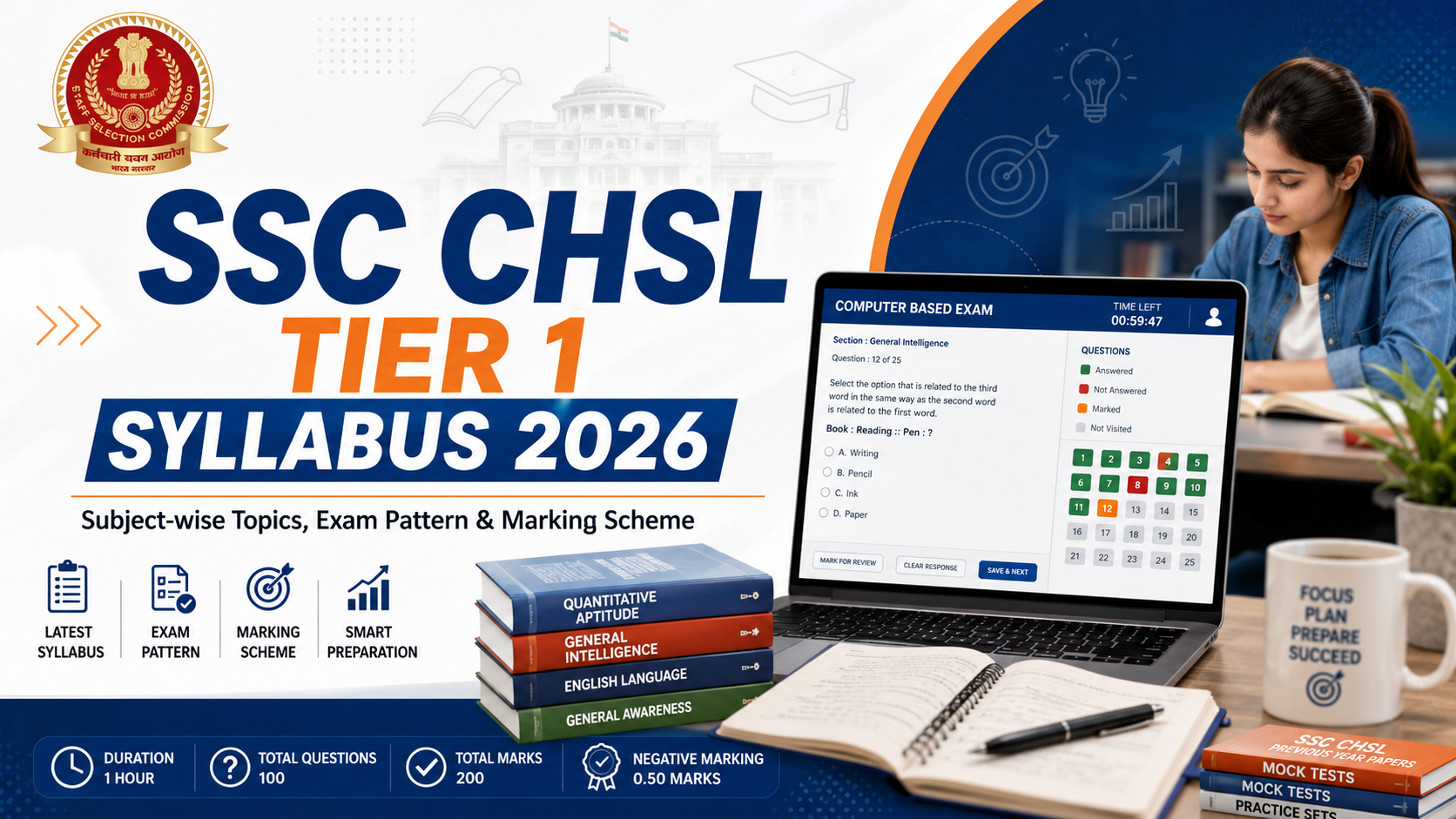
SSC CHSL Tier 1 Syllabus 2026
NEW
AngularJS Interview Questions and Answers
NEW
Difference Between HTML and XML (HTML vs XML)
NEW
CBSE 12th Result 2026 Re-Evaluation: Apply Online, Fees, Last Date & Step-by-Step Process Explained
NEW
NEET UG 2026 Re-Exam Date Announced: Check New Exam Date, Schedule & Latest Updates
NEW
Understanding the SSC Phase 14 Exam: A Comprehensive Overview
NEW
Top Study Tips for Cracking Your Exams with Confidence
NEW
Aerospace Engineering: Scope, Courses & Career Opportunities
NEW
SSC CHSL Syllabus
NEW
EPFO 3.0 is Here: 7 Major Changes Every Employee Must Know
NEW